 BTR Enerji · Solar Tracker
Hail Stow Strategy for Solar Trackers: How Much Energy Does It Cost, and Which Way Should Panels Turn?
Turning a tracker to a steep angle (stow) when hail is forecast is the fastest way to protect the modules, but every stow hour costs production. We calculated it with our simulator at four sites: one hour of hail stow on a summer afternoon costs 374 kWh/MWp in Konya; with the panels tilted towards the sun the loss drops to 96 kWh/MWp. Twenty hours of stow a year cost only 0.09–0.36% of annual yield, depending on direction.
Short answer
The energy cost of hail stow is small: even assuming 10 events × 2 hours a year, it is one to four tenths of a percent of annual yield. So the real question is not whether to stow, but when, how early and in which direction. For protection, the direction is set by the incoming hail (wind) direction and the manufacturer's instructions; where both directions are acceptable, tilting towards the sun cuts the loss to between a quarter and a third. False-alarm stows are cheap too; the real risk is a tracker that is not in stow when the hail arrives.
What is hail stow and how does it differ from wind stow?
In wind stow the modules move close to flat to reduce wind load. In hail stow they rotate to a steep angle: hailstones strike the glass at a more glancing angle, so the impact component normal to the glass, and with it the breakage risk, is reduced. Because the two strategies call for opposite positions, most control logics give wind stow priority once the wind threshold is exceeded during a storm. For a drawing of the three positions see our wind stow article.
How did we calculate it?
- Our simulator computed hourly AC output for a 5-hectare single-axis tracker site (backtracking, 710 W bifacial modules, PVGIS typical-year data).
- For the same hours we computed with pvlib the irradiance a module would receive at a 55° stow angle (tilted east or west), including shading from neighbouring rows. Stow output was scaled from normal tracking output by the irradiance ratio.
- Stow facing away from the sun: tilted west before solar noon and east after it. Stow facing the sun: the opposite.
- For the annual effect we used a representative scenario: 20 hours of stow between 13:00 and 17:00 in the summer months (May–July), e.g. 10 events × 2 hours.
Note: real hailstorms usually arrive with heavy cloud, when output is already low. The values in the table are averages that include near-clear-sky hours and should be read as close to an upper bound.
How much energy does one hour of hail stow cost?
| Site | Annual yield (kWh/kWp) | 1 h stow facing away (kWh/MWp) | 1 h stow facing the sun (kWh/MWp) | 20 h/yr: facing away | 20 h/yr: facing the sun |
|---|---|---|---|---|---|
| Konya (Turkey) | 2,093 | 374 | 96 | 0.36% | 0.09% |
| Seville (Spain) | 2,226 | 371 | 141 | 0.33% | 0.13% |
| Foggia (Italy) | 1,884 | 332 | 98 | 0.35% | 0.10% |
| Midland, Texas (US) | 2,422 | 400 | 142 | 0.33% | 0.12% |
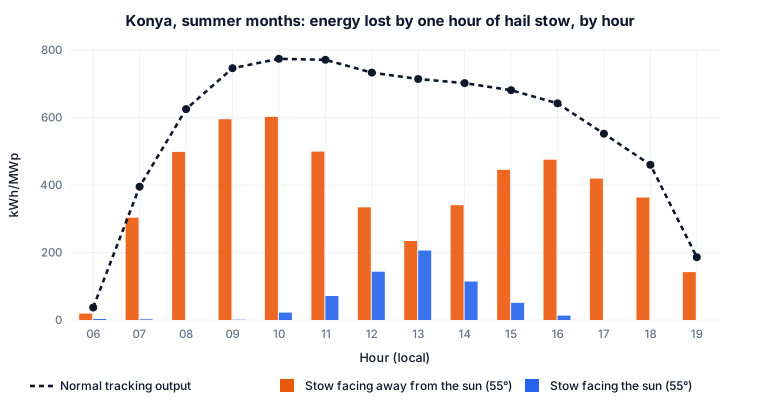
With stow facing away from the sun the loss exceeds half of normal output: 602 kWh/MWp at 10:00 in Konya. Facing the sun, the loss is almost zero in the morning and evening, when the tracker already operates close to 55°; it peaks at midday, when the module is furthest from the sun (206 kWh/MWp). The picture is similar at all four sites: choosing the direction cuts the afternoon loss to between a quarter and a third.
Pick your location and draw your land on the map. Get hourly-weather-based yield, a tracker vs fixed-tilt comparison, a bill of materials and the payback period, free of charge.
Free Solar Tracker Simulation
How should the stow direction be chosen?
- Protection first: the glass should not face the direction from which wind-driven hail arrives. Which direction protects is defined by the tracker and module manufacturers' stow instructions.
- Then energy: if the storm front's direction is uncertain, or both directions are acceptable for protection, tilting towards the sun minimises the loss.
- Consider the wind: wind load rises at steep angles; the logic for switching to wind stow in sudden gusts must be explicit.
When should it be triggered?
Hail stow can be triggered by a weather service (radar-based nowcasting), an on-site weather station or an operator command from SCADA. Rotating a whole site to the stow angle takes minutes, so the warning must arrive well before the hail reaches the site. Our results show that early and frequent stows are cheap: one extra hour of stow on a summer afternoon, facing the sun, costs 96 kWh/MWp in Konya, only 0.005% of a megawatt-peak's annual yield. Replacing a single broken module, plus the downtime, costs far more, so thresholds and lead times should be chosen conservatively.
Insurance and financing
In hail-prone regions insurers and lenders increasingly ask about a site's hail protection strategy: trigger method, stow angle, warning lead time and event logs. A documented and tested stow procedure strengthens the site's position in those discussions. Premiums and cover vary by insurer and region, so we give no figures here.
Method and limitations
- Model: hourly tracker output from our simulator; for the stow position an isotropic sky model with neighbouring-row shading (pvlib). The electrical effect of partial shading is not modelled separately; the real loss may be somewhat higher.
- Weather data: PVGIS typical meteorological year; hail frequency and timing are not modelled, and the 20-hour scenario is illustrative.
- These are simulation results, not measurements. You can see annual yield and wind stow losses for your own site in the simulator.
Related reading: Solar tracker wind stow strategy · P50 and P90 explained · Solar tracker vs fixed tilt
Frequently asked questions
What is the hail stow position of a solar tracker?
It is the tracker rotating the modules to a steep angle (for example 55–60°) when hail is forecast. Hailstones then strike the glass at a more glancing angle, reducing the normal impact component and the breakage risk.
How much production does hail stow cost?
In our simulations, 20 hours of stow on summer afternoons cost between 0.09–0.13% (facing the sun) and 0.33–0.36% (facing away) of annual yield across four sites.
Which way should panels turn in hail stow?
Protection first: the glass should not face the direction of wind-driven hail, as defined by the manufacturer's instructions. If both directions are acceptable, tilting towards the sun cuts the energy loss to between a quarter and a third.
What if hail stow conflicts with wind stow?
The two strategies call for opposite positions: near flat for wind, steep for hail. In most control logics wind stow takes priority once the wind threshold is exceeded.
We deliver the whole project: feasibility, engineering, procurement, installation and grid connection, in Türkiye and abroad. Simulate your site for free first, then let our team prepare a tailored quote.
Start the Simulation and Get a Quote
The ratios on this page are typical industry ranges and are not binding; exact values are determined by a site-specific analysis.