 BTR Enerji · Solar Tracker
Bifacial Modules on Solar Trackers: How Ground Albedo Changes Rear-Side Gain
A bifacial module also converts the reflected and diffuse light that reaches its rear side. How much does that add on a single-axis tracker, and what does it depend on? We ran the same plant at 8 locations in our simulator: on grass (albedo 0.25) the bifacial gain ranged from 2.5% to 8.7%. Ground colour, row spacing and snow all move that number noticeably.
The short answer
Bifacial gain is driven mainly by ground reflectance (albedo): in Konya, every 0.10 increase in albedo added about 1.5 percentage points of rear-side contribution. The second factor is row density (GCR): denser rows let less light reach the rear side. The third is climate: the gain is proportionally larger in cloudy, snowy regions with a high diffuse share and smaller in very sunny, dry deserts.
What is bifacial gain and how did we measure it?
Here bifacial gain means how much more the same tracker plant produces with bifacial modules than with the front side alone. Our module is a 710 W n-type double-glass bifacial module with a bifaciality of 80% (datasheet value). The simulation deducts 5% of rear irradiance for torque-tube shading and 3% for non-uniform rear light (mismatch), so these are not "ideal rear side" figures.
Bifacial gain by albedo at 8 locations
At each location we ran the same plant (5 ha, about 3 MWp, GCR 0.32, north-south axis tracker with backtracking) four times with PVGIS typical meteorological year data, holding albedo constant all year:
| Location | Soil 0.17 | Grass 0.25 | Sand 0.35 | Snow 0.65* | Tracker specific yield, grass (kWh/kWp·yr) |
|---|---|---|---|---|---|
| Bavaria (Germany) | 6.6 % | 8.7 % | 11.2 % | 17.4 % | 1,484 |
| Edirne | 5.4 % | 7.0 % | 8.8 % | 13.2 % | 1,831 |
| Van | 4.6 % | 6.0 % | 7.5 % | 11.2 % | 2,115 |
| Konya | 4.6 % | 6.0 % | 7.5 % | 10.8 % | 2,233 |
| Riyadh | 4.5 % | 5.8 % | 7.2 % | 9.9 % | 2,402 |
| Antalya | 4.0 % | 5.2 % | 6.5 % | 9.6 % | 2,212 |
| Seville | 4.0 % | 5.2 % | 6.5 % | 9.8 % | 2,274 |
| Atacama (Chile) | 1.8 % | 2.5 % | 3.1 % | 4.5 % | 2,823 |
* 0.65 all year is not a realistic scenario; it is kept as an upper bound for snow. A realistic snow calculation follows below.
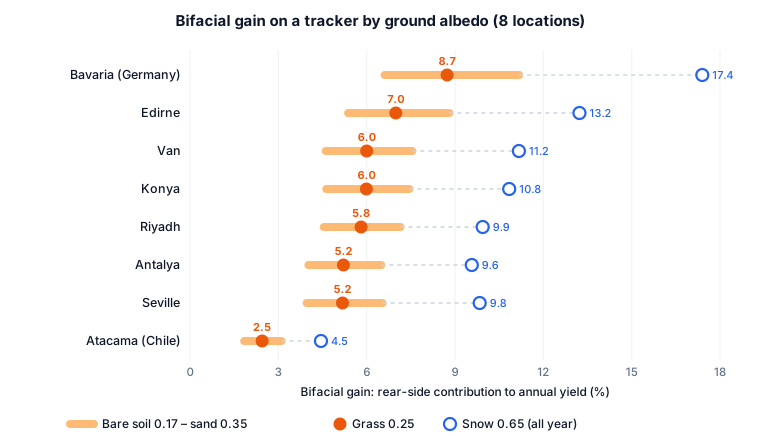
How to read it: in Konya, moving from bare soil to sand (same modules, same tracker) raises annual yield by 69 kWh/kWp, or 3.2%, roughly 69 MWh per MWp per year. Ground colour is not a free design parameter, but it is far from negligible.
Why high in Bavaria and low in the Atacama?
The rear side receives most of its light as diffuse irradiance from the sky and reflection from the ground. In a cloudy climate the front side gets less direct light, so the rear side's relative share grows: 8.7% on grass in Bavaria. In the Atacama the front side already receives very strong direct irradiance (2,823 kWh/kWp, by far the highest on the list), so the rear-side contribution stays at 2.5%; inverter clipping at midday can also cut part of the extra energy. A high bifacial percentage alone does not make a good site; total kWh/kWp is what counts.
Note: the real albedo of desert sites such as the Atacama is often higher than grass. For comparison every location used the same ground; for your own site use measured albedo or a value that matches the ground type.
Pick your location and draw your land on the map. Get hourly-weather-based yield, a tracker vs fixed-tilt comparison, a bill of materials and the payback period, free of charge.
Free Solar Tracker Simulation
How much does snow add to rear-side gain?
By default our simulator checks the Open-Meteo ERA5 snow-depth climate normal for each location and raises albedo in snowy months. With this automatic calculation bifacial gain in Van (eastern Türkiye) rose from 6.0% to 8.0% and annual yield increased by 45 kWh/kWp (2.1%). The effect is small in Konya (6.0% → 6.2%) because snow cover is short-lived, and small in Bavaria (8.7% → 8.9%) because irradiance itself is low in the snowy winter months.
Snow has another side: snow on the modules covers the front. A tracker can tilt modules steeply under snow load to help it slide off; that is an operating setting and varies by product.
How does row density (GCR) affect the gain?
As rows get denser the rear side sees less sky and more of the ground beneath the rows is shaded. Raising GCR from 0.25 to 0.50 on the same land cut the bifacial gain from 6.5% to 4.3% in Konya and from 5.2% to 3.3% in Seville.
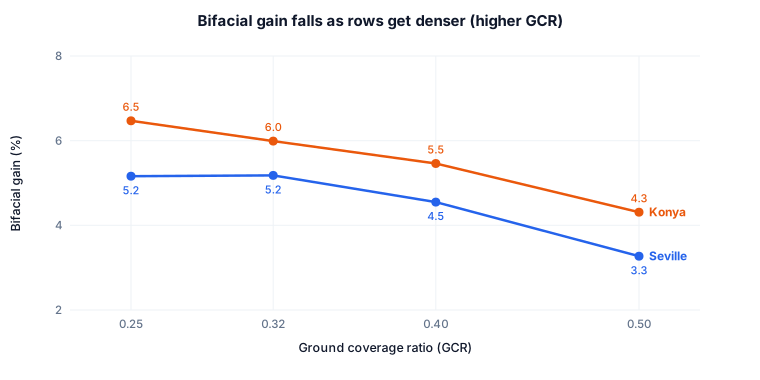
This does not make dense rows bad: at GCR 0.50 twice as many modules fit on the same land. The balance between added capacity and lower output per module is an investment decision, and bifacial gain is only one input to it. Choose GCR on project economics, not on the bifacial percentage.
How much does tracker height matter?
We did not quantify height in this article. The 2D infinite-row model we use, which is common in the industry (pvlib infinite_sheds), treats rows as infinitely long and is almost insensitive to height: raising it from 1.5 m to 3 m left rear irradiance practically unchanged in the model. In the field, height affects how evenly light reaches the rear side, especially at row ends and on narrow sites. Rather than quote a figure not backed by measurements, we state this openly as a model limit.
Using bifacial gain correctly in design
- Enter site-specific albedo. The difference between grass, soil, gravel and sand reaches 69 kWh/kWp a year in the Konya example. If vegetation changes with the seasons, use a monthly albedo table.
- Show rear-side losses explicitly. A "bifacial gain" without torque-tube shading and rear mismatch is optimistic.
- Account for snow climate. In regions with snowy winters, winter albedo can shift annual yield by a couple of percent.
- Remember the current side. Rear-side gain raises current, not voltage; check cables, fuses and inverter MPPT current limits against it (see 1500 V string sizing).
Method and limits
- Weather: PVGIS typical meteorological year (TMY), hourly; for the snow scenario, the Open-Meteo ERA5 snow-depth climate normal.
- Model: pvlib infinite_sheds (front and rear), backtracking, temperature, soiling, incidence angle (IAM), cabling and mismatch, inverter clipping, MV transformer losses.
- These are simulation results, not measurements. They compare locations and ground types with one consistent method; for uncertainty ranges see P50 and P90 explained.
Related: Solar tracker energy gain at 25 sites · Solar tracker vs fixed-tilt · Wind stow strategy.
Frequently asked questions
How much extra energy do bifacial modules produce on a tracker?
In our simulations on grass (albedo 0.25) the rear-side contribution ranged from 2.5% to 8.7% across 8 locations, after deducting torque-tube shading and rear mismatch.
What is albedo and how does it affect bifacial gain?
Albedo is the share of light the ground reflects: about 0.17 for bare soil, 0.25 for grass, 0.35 for sand and above 0.6 for fresh snow. In the Konya simulation every 0.10 increase in albedo raised bifacial gain by about 1.5 percentage points.
Why is bifacial gain higher in cloudy regions?
The rear side gets most of its light from diffuse irradiance and ground reflection. In cloudy climates the front side's direct light falls, so the rear side's relative share rises; total yield is still higher at sunny sites.
Do dense rows (high GCR) reduce bifacial gain?
Yes. Raising GCR from 0.25 to 0.50 cut bifacial gain in Konya from 6.5% to 4.3%. Dense rows fit more capacity on the same land, though, so GCR should be chosen on project economics.
We deliver the whole project: feasibility, engineering, procurement, installation and grid connection, in Türkiye and abroad. Simulate your site for free first, then let our team prepare a tailored quote.
Start the Simulation and Get a Quote
The ratios on this page are typical industry ranges and are not binding; exact values are determined by a site-specific analysis.