 BTR Enerji · Solar Tracker
Solar Tracker Operation and Maintenance (O&M): What Does a Stuck Row Cost, and What Should Be Inspected?
The most expensive O&M problem on a tracker site is often the invisible one: a stuck row that nobody has noticed. We calculated it at four sites: a tracker stuck in the flat position loses 19.6–23.4% of that row's annual yield; stuck at 55° east the loss rises to 31.8–35.6%. In July in Konya that is about 2,066 kWh per MWp per day.
Short answer
Trackers need somewhat more maintenance than fixed-tilt structures: there are moving and electronic parts such as motors, gearboxes, controllers and angle sensors. What really drives O&M cost, though, is how quickly faults are detected. The loss from a stuck row accumulates day after day in summer; a monitoring system that tracks angle feedback and row-level output is the most profitable part of maintenance. If a row fails, putting it flat is both safer and less costly than leaving it tilted.
How much energy does a stuck tracker lose?
We computed hourly output for a 5-hectare site with our simulator; for the same hours we computed with pvlib the irradiance a module would receive fixed flat (0°) and fixed at 55° east, including neighbouring-row shading, and scaled output by that ratio.
| Site | Annual yield (kWh/kWp) | Stuck flat: annual loss | Stuck at 55° east: annual loss | Stuck flat: July (kWh/MWp·day) |
|---|---|---|---|---|
| Konya (Turkey) | 2,093 | 19.6% | 33.5% | 2,066 |
| Seville (Spain) | 2,226 | 21.1% | 35.6% | 2,023 |
| Foggia (Italy) | 1,884 | 19.6% | 33.1% | 1,793 |
| Midland, Texas (US) | 2,422 | 23.4% | 31.8% | 2,039 |
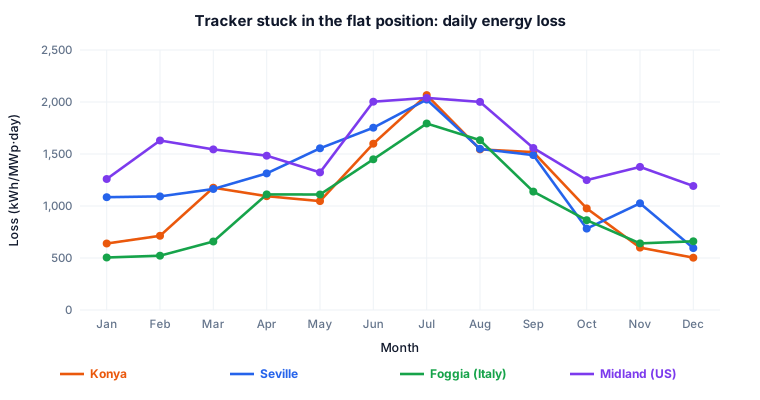
The loss peaks in summer: 2,066 kWh per MWp per day in July in Konya versus 503 kWh in December. A fault that goes unnoticed for two weeks in midsummer costs roughly three to four times as much energy as the same fault in winter. Being stuck flat costs clearly less than being stuck tilted, and flat is also the safe position for wind load.
How does availability affect plant output?
A simple rule: plant loss ≈ share of faulty trackers × loss ratio in the stuck position. If 1% of trackers stayed stuck flat all year, plant output would fall by about 0.20–0.23%. The number looks small, but availability guarantees and performance-ratio targets in contracts make such losses measurable, and the effect is larger if faults cluster in summer.
Pick your location and draw your land on the map. Get hourly-weather-based yield, a tracker vs fixed-tilt comparison, a bill of materials and the payback period, free of charge.
Free Solar Tracker Simulation
What should preventive maintenance cover?
- Drive and gearbox: visual inspection, abnormal noise and vibration, motor-current trend (rising current signals friction or mechanical strain).
- Tracker controller (TCU) and communications: firmware version, clock synchronisation, communication drop-outs, fault logs.
- Angle sensor: compare commanded and measured angles; an error of a few degrees disrupts backtracking and creates morning and evening shading losses.
- Wind and weather sensors: anemometer calibration and placement; wrong readings cause unnecessary stows or, worse, missed ones.
- Bearings and torque tube: bolt torques (by sampling), fasteners, corrosion. Our product uses lubrication-free, UV-resistant polymer bearings, so there is no periodic greasing item; inspection is visual.
- Piles and ground: corrosion, settlement, erosion and drainage, especially in graded areas.
- Vegetation: keep ground clearance under the module's lower edge at maximum tilt; tall grass causes both shading and fire risk.
- Module cleaning: align the washing plan with tracker positions; rows are moved to a suitable angle during cleaning.
Monitoring: how to catch faults early
- Angle feedback: the difference between each table's actual and target angle should raise an alarm.
- Row-level output comparison: comparing string currents on the same inverter reveals a stuck row even without angle data; the difference is clearest in the morning and evening.
- Stow logs: record the cause, duration and return time of every stow event; the logs also help with insurance and warranty claims.
- Spare parts: stock motors, controllers and sensors in proportion to the number of tables, with a critical stock for long-lead-time parts.
Method and limitations
- Model: hourly tracker output from our simulator (PVGIS typical year, 710 W bifacial modules); isotropic sky model with neighbouring-row shading for the fixed positions. The change in rear-side gain with position is not modelled separately.
- Scope: loss of a single row; shading of neighbouring rows by a faulty row (e.g. one stuck at 55°) is not included.
- These are simulation results, not measurements.
Related reading: Solar tracker hail stow strategy · Solar tracker wind stow strategy · Terrain-aware backtracking
Frequently asked questions
Are solar trackers hard to maintain?
They have somewhat more items than fixed-tilt systems (motor, gearbox, controller, sensors), but most checks are done through remote monitoring. What matters most is detecting faults early.
How much production does a faulty tracker lose?
In our simulations a tracker stuck flat lost 19.6–23.4% of that row's annual yield; one stuck at 55° east lost 31.8–35.6%.
Which position should a failed tracker be put in?
Flat, where possible. The flat position is safe for wind load and loses less energy than being stuck tilted.
Do tracker bearings need lubrication?
It depends on the product. Ours uses lubrication-free, UV-resistant polymer bearings; visual inspection is enough during periodic maintenance.
We deliver the whole project: feasibility, engineering, procurement, installation and grid connection, in Türkiye and abroad. Simulate your site for free first, then let our team prepare a tailored quote.
Start the Simulation and Get a Quote
The ratios on this page are typical industry ranges and are not binding; exact values are determined by a site-specific analysis.