 BTR Enerji · Solar Tracker
String Sizing at 1500 V: Cold-Temperature Voc and the Maximum Modules per String
A 28-module string that runs safely in Seville can exceed 1500 V on a cold winter morning in Ankara. This article walks through the cold-temperature Voc calculation that sets string length, and uses 10 years of hourly climate data for 12 locations to show where a 28-module string fits and where it does not.
The short answer
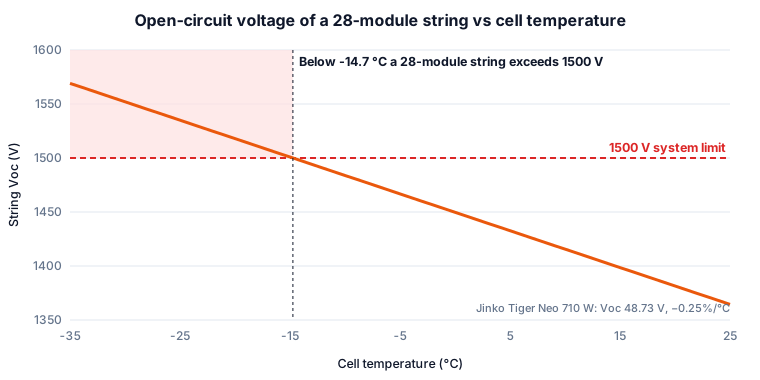
The maximum number of modules per string in a 1500 V system is n = 1500 / Voc(Tmin), rounded down. For our default module, a Jinko Tiger Neo 710 W (Voc 48.73 V, −0.25%/°C), a 28-module string exceeds 1500 V once the cell temperature drops below −14.7 °C. Warm climates can use 28 modules; cold continental sites need 27 or fewer.
Why cold weather sets the string length
A module's open-circuit voltage (Voc) rises as temperature falls. The highest voltage appears on a clear winter morning at first light: the air is at its coldest, the modules have not warmed up and the string is open-circuit before the inverter connects. If that voltage exceeds the inverter's maximum DC input (1500 V), the inverter can be damaged and the warranty voided. That is why IEC 62548 and similar codes require the maximum string voltage to be calculated at the site's lowest expected temperature.
The formula and a worked example
Voc(T) = Voc,STC × [1 + β × (T − 25)]
β is the Voc temperature coefficient (%/°C, negative). For the example module β = −0.25%/°C, about 0.122 V per degree:
- −10 °C: Voc = 48.73 × [1 + 0.0025 × 35] = 52.99 V → 28 × 52.99 = 1,484 V ✓
- −20 °C: Voc = 54.21 V → 28 × 54.21 = 1,518 V ✗ → maximum 27 modules (1,464 V)
Which temperature should you use?
The design temperature is where most mistakes happen:
- Absolute record low: the safest option, but it includes night-time lows when modules produce no voltage, so it can be overly strict.
- Lowest daylight temperature: voltage only appears with light. At dawn irradiance is low, so cell temperature is very close to air temperature.
- Our simulator's method: the lowest temperature in hours with irradiance above 20 W/m², minus a 5 °C safety margin, because hourly averages smooth out short cold spells. (In the US, NEC 690.7 commonly uses the ASHRAE extreme annual mean minimum design temperature.)
Does a 28-module string fit? Results for 12 locations
We downloaded hourly temperature and irradiance for 2015–2024 from the Open-Meteo ERA5 archive for each location and applied the method above:
| Location | Lowest daylight temperature (ERA5 2015–2024) | Design temperature | Module Voc (cold) | Max modules at 1500 V |
|---|---|---|---|---|
| Copiapó (Chile) | 4.8 °C | -0.2 °C | 51.80 V | 28 |
| Seville | 1.7 °C | -3.3 °C | 52.18 V | 28 |
| Riyadh | 0.9 °C | -4.1 °C | 52.28 V | 28 |
| Antalya | -2.3 °C | -7.3 °C | 52.66 V | 28 |
| Izmir | -3.1 °C | -8.1 °C | 52.76 V | 28 |
| Sanliurfa | -3.7 °C | -8.7 °C | 52.84 V | 28 |
| Madrid | -6.7 °C | -11.7 °C | 53.20 V | 28 |
| Midland (Texas) | -14.4 °C | -19.4 °C | 54.14 V | 27 |
| Konya (Karapinar) | -17.6 °C | -22.6 °C | 54.53 V | 27 |
| Ankara | -19.9 °C | -24.9 °C | 54.81 V | 27 |
| Bucharest | -23.4 °C | -28.4 °C | 55.24 V | 27 |
| Erzurum | -26.6 °C | -31.6 °C | 55.63 V | 26 |
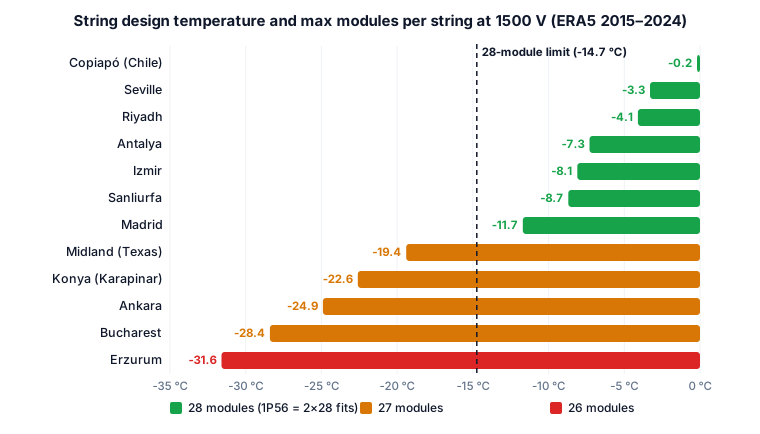
The pattern is clear. The Mediterranean and Aegean coasts, southern Spain, the Gulf and the Atacama easily take 28 modules. Madrid is close to the limit (1,490 V). Continental climates such as Central and Eastern Anatolia, Romania and West Texas need 27 or even 26 modules.
Pick your location and draw your land on the map. Get hourly-weather-based yield, a tracker vs fixed-tilt comparison, a bill of materials and the payback period, free of charge.
Free Solar Tracker Simulation
What it means for tracker table length
A good tracker design keeps the number of modules per table an exact multiple of the string length, so no string is split across two tables and no jumper cables are needed. A 56-module table (1P56) is classically wired as 2 × 28. When 28 does not fit, the options are:
- A shorter catalogue table: for example a 32-module table wired 2 × 16 is safe in any climate. Our simulator does this automatically when the selected table does not suit the site's climate, and flags it as an "electrical fit" change.
- A custom table length: a 54-module table (2 × 27) reduces the land penalty if your tracker supplier offers it.
- Strings spanning tables: possible, but it complicates cabling, installation and fault finding; we do not recommend it.
Don't forget the hot side: the MPPT minimum
Shortening strings has a limit too. On a summer day with 70 °C cells the operating voltage (Vmp) drops to about 35.2 V for the example module. Sixteen modules give about 563 V, above the typical 500 V MPPT minimum of 1500 V inverters; fourteen give about 492 V, below it. We used the Voc coefficient as an approximation for Vmp; the real Vmp coefficient is usually slightly larger, so keep a margin.
Checklist
- Take Voc and β from the current datasheet of the selected module; bifacial rear gain raises current, not voltage.
- Set the design temperature from multi-year hourly data for the site, using daylight hours plus a safety margin.
- Check the maximum voltage against the inverter's maximum DC input, and the hot Vmp against the MPPT minimum.
- Choose a table length that is an exact multiple of the string; if it does not fit, move to a shorter table.
Frequently asked questions
How many modules can be connected in a 1500 V string?
It depends on the module Voc and the site's design temperature. For a 710 W class TOPCon module it is 28 in warm climates and 26-27 in cold continental climates. Calculation: 1500 V / Voc(Tmin), rounded down.
Which temperature is used for string sizing?
The lowest expected temperature. Because voltage only appears with light, the lowest daylight temperature can be used; add a few degrees of margin because hourly data smooth out short cold spells.
What happens if the string exceeds 1500 V?
The inverter's DC input can be damaged and the manufacturer's warranty voided. The string voltage must stay below the limit even on the coldest morning.
Do bifacial modules increase string voltage?
Not significantly. Rear-side gain mainly increases current; cables and fuses should be sized for the current including bifacial gain.
We deliver the whole project: feasibility, engineering, procurement, installation and grid connection, in Türkiye and abroad. Simulate your site for free first, then let our team prepare a tailored quote.
Start the Simulation and Get a Quote
The ratios on this page are typical industry ranges and are not binding; exact values are determined by a site-specific analysis.