 BTR Enerji · Solar Tracker
Solar Tracker Wind Stow Strategy: Threshold, Gust Factor and Real Energy Loss
In strong wind a single-axis tracker moves its modules to a safe position, known as stow. It is essential for safety, but every stow hour is production given up. How much does that cost over a year? We calculated it in our simulator with hourly wind data for 12 locations: at an 18 m/s gust threshold the annual loss stayed below 0.2% at 11 of them; lowering the threshold to 12 m/s raised it to 4.7% at the windiest site.
The short answer
Stow loss is very sensitive to the threshold and comparatively insensitive to a site's general wind climate. The manufacturer sets the structurally safe gust threshold for the product (18 m/s for our tracker); you cannot raise it to protect yield, you can only measure wind correctly. That takes two things: the gust factor and the site's real wind data.
Why stow is needed
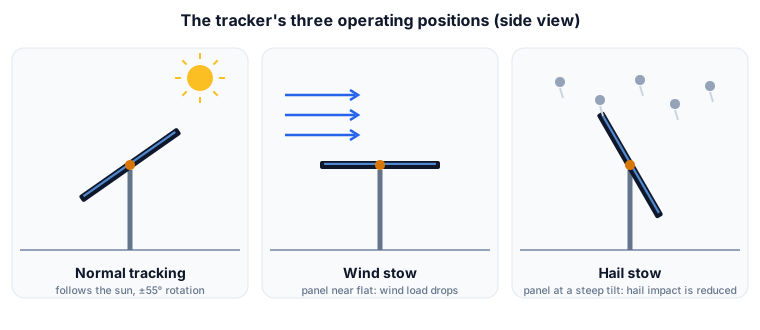
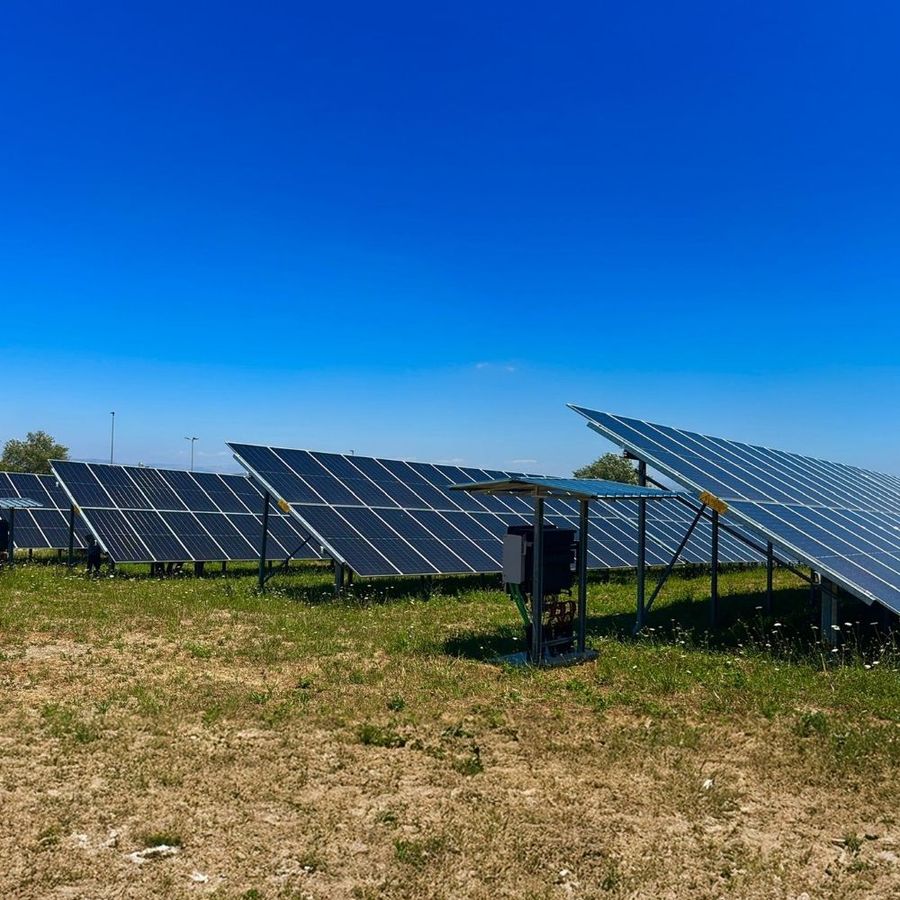
A tracker presents the module to the wind as a large surface. Near flat, wind load falls; at a steep angle, lift and torsion rise. The tracker control unit (TCU) therefore watches the wind sensor and moves every table to a safe position once the threshold is exceeded. Depending on the product the position can be flat or an angle set relative to the wind, and a separate mode can hold the modules at a steep tilt for hail. A stow hour is not a production hour: the module does not face the sun.
The threshold: hourly mean or gust?
Manufacturers usually state the threshold as a 3-second gust, while meteorological datasets (PVGIS, ERA5) provide hourly mean wind. The bridge between the two is the gust factor: gust ≈ hourly mean × factor. It is about 1.4–1.6 in open terrain and 1.7 or more in rough or wooded terrain. Our simulator defaults to 1.5, so an 18 m/s gust threshold corresponds to an hourly mean of 12 m/s.
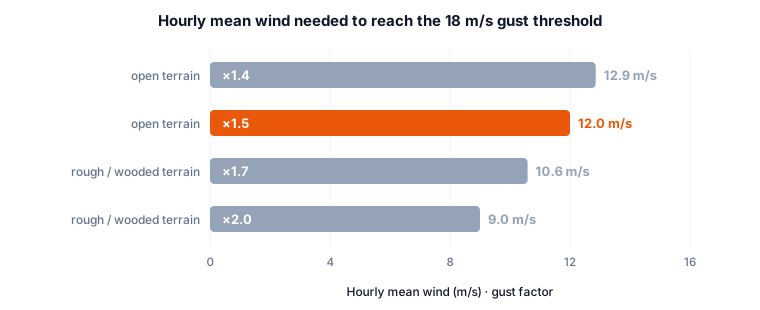
Misreading the threshold therefore errs in both directions: ignore the gust factor and you find too few stow hours; exaggerate it and you find too many.
How many stow hours a year at 12 locations?
For each location we ran the simulation with PVGIS typical meteorological year (TMY) hourly wind, a 1.5 gust factor and thresholds of 12 and 18 m/s:
| Location | 12 m/s: hours (loss) | 15 m/s: hours (loss) | 18 m/s: hours (loss) |
|---|---|---|---|
| Comodoro Rivadavia (Argentina) | 1,855 (4.74%) | 630 (1.66%) | 93 (0.19%) |
| Midland (Texas) | 501 (1.37%) | 73 (0.25%) | 2 (0.02%) |
| Zaragoza | 267 (1.18%) | 16 (0.06%) | 0 (0%) |
| Çanakkale | 84 (0.05%) | 3 (0%) | 0 (0%) |
| Munich | 46 (0.03%) | 8 (0%) | 0 (0%) |
| Calama (Chile) | 29 (0.10%) | 5 (0.01%) | 0 (0%) |
| Konya | 21 (0.05%) | 0 (0%) | 0 (0%) |
| Seville · Antalya · Izmir · Erzurum · Hermosillo | 0–12 (0%) | 0 (0%) | 0 (0%) |
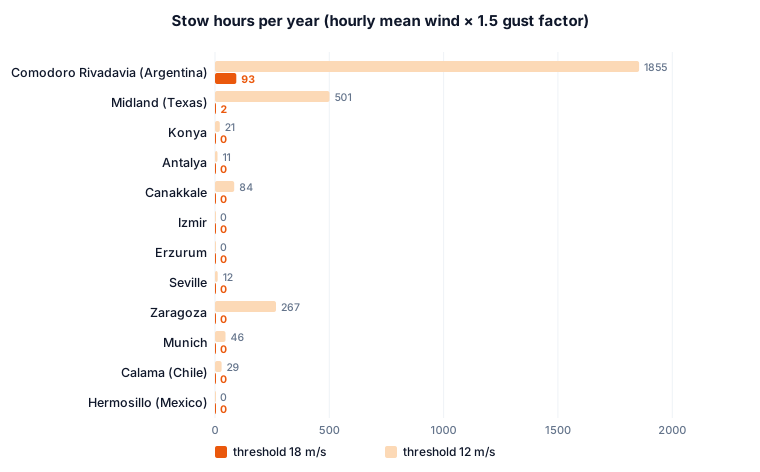
The table is clear: at an 18 m/s threshold, stow is no more than a few hours a year at most sites and costs less than 0.2% of yield. Only a very windy site such as Patagonia reaches hundreds of hours. That the loss percentage is smaller than the share of hours is normal: many windy hours are low-irradiance or night hours.
Pick your location and draw your land on the map. Get hourly-weather-based yield, a tracker vs fixed-tilt comparison, a bill of materials and the payback period, free of charge.
Free Solar Tracker Simulation
What if the threshold is lowered?
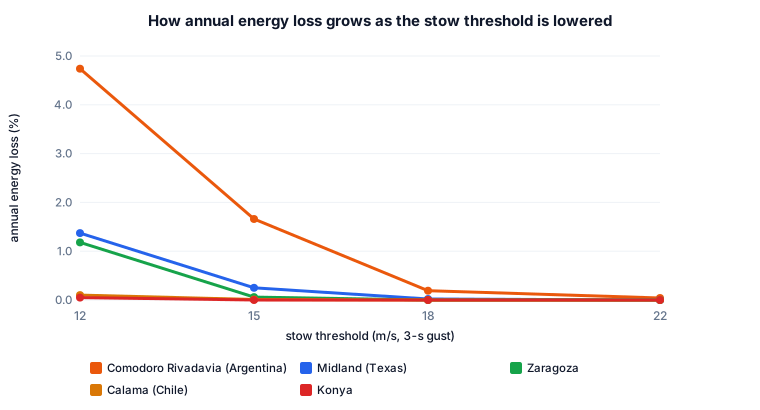
The threshold rests on the manufacturer's structural tests and is not a setting you choose. But "what would a more conservative threshold cost?" is a useful question for projects. The loss grows faster than linearly as the threshold drops:
How to read these results: limits
- TMY is a typical year. It smooths rare, severe storms, so read stow hours as a lower bound. A windy site needs multi-year measured data.
- Wind is at 10 m height. The tracker torque tube sits a few metres up and wind at module height is usually lower than at 10 m, so the calculation errs on the conservative side.
- Hourly means hide gusts. The gust factor approximates that; measured 1–10 minute wind data is best.
- The threshold is product-specific. The 18 m/s here is our tracker's TCU/RSU setting; enter the manufacturer's value for another product.
Hail protection (high-tilt stow) follows a similar logic, but because hail events are local and rare we give no figures here. Insurance terms should be discussed with the insurer.
Design checklist
- Ask the manufacturer for the stow threshold as a gust (3 s) value, backed by a structural test report.
- Get multi-year wind data for the site; raise the gust factor to 1.7 or more in rough or wooded terrain.
- Plan the number and position of wind sensors (RSU) for the site size and wind direction.
- Show stow loss as its own line in the energy model; do not bury it in the loss total.
Related: Solar tracker design software · Terrain-aware backtracking.
Frequently asked questions
How much does wind stow reduce tracker yield?
It depends on the threshold. At an 18 m/s gust threshold the annual loss was below 0.2% at 11 of the 12 locations we examined, and 0.19% at a very windy Patagonian site. At a 12 m/s threshold it can reach 4.7% at the windiest site.
What is the gust factor?
The ratio of a 3-second wind gust to the hourly mean wind. It is about 1.4–1.6 in open terrain and 1.7 or more in rough or wooded terrain, and it is needed to compute stow from hourly meteorological data.
Who sets the stow threshold?
The tracker manufacturer, based on structural tests of the product. A project owner should not raise it to increase yield; the job is to measure the site's wind correctly and forecast the loss.
Are these calculations exact?
No. PVGIS typical-year data smooth rare storms, so stow hours are a lower bound; a definitive assessment needs measured multi-year wind data.
We deliver the whole project: feasibility, engineering, procurement, installation and grid connection, in Türkiye and abroad. Simulate your site for free first, then let our team prepare a tailored quote.
Start the Simulation and Get a Quote
The ratios on this page are typical industry ranges and are not binding; exact values are determined by a site-specific analysis.