 BTR Enerji
Solar Tracker Snow Loss and Snow Load: Simulation Data for Cold Sites
Using 10 years of snowfall data, our simulation puts annual tracker snow-cover loss between 0.01% and 1.0% across eight sites. Fixed tilt loses slightly more. But the figure is very sensitive to the model's snowfall threshold: with a lower threshold, the Erzurum result rises to 5.3%. In cold climates the main design questions are whether snow has room to slide and what load the structure carries. These are simulations, not measurements.
Short answer: how much does snow reduce tracker output?
- The modelled loss is small: about 1.0% a year in Van and Erzurum, 0.3% in Sofia, 0.1% in Munich.
- It varies year to year: in Van, 0.2% in the best year and 2.1% in the worst.
- Uncertainty is larger than the loss: lowering the snowfall threshold from 1.0 to 0.2 cm/h moves Erzurum from 1.0% to 5.3%. Use a range, not a single number.
- The shedding angle helps: waiting at 15° instead of 55° raises the modelled Erzurum loss from 1.0% to 2.2%.
Pick your location and draw your land on the map. Get hourly-weather-based yield, a tracker vs fixed-tilt comparison, a bill of materials and the payback period, free of charge.
Free Solar Tracker Simulation
How large is snow-cover loss by site?
We ran the same plant at eight sites and fed in 2016–2025 snowfall year by year. The last column is the tracker's energy gain over fixed tilt, including snow and snow-covered ground.
| Site | Annual snowfall (cm) | Tracker snow loss | Best – worst year | Fixed-tilt snow loss | Snow depth ≥ 0.52 m (days/yr) | Tracker gain |
|---|---|---|---|---|---|---|
| Van | 109 | 1.0% | 0.2% – 2.1% | 1.3% | 12 | 19.7% |
| Erzurum | 98 | 1.0% | 0.4% – 1.5% | 1.2% | 26 | 18.6% |
| Kars | 101 | 0.6% | 0.1% – 1.3% | 0.8% | 2 | 18.1% |
| Sofia | 61 | 0.3% | 0.0% – 1.2% | 0.4% | 0 | 15.7% |
| Krakow | 58 | 0.1% | 0.0% – 0.4% | 0.2% | 0 | 12.3% |
| Munich | 70 | 0.1% | 0.0% – 0.4% | 0.1% | 0 | 12.5% |
| Bucharest | 45 | 0.1% | 0.0% – 0.3% | 0.1% | 0 | 14.9% |
| Madrid | 6 | 0.0% | 0.0% – 0.1% | 0.0% | 0 | 20.4% |
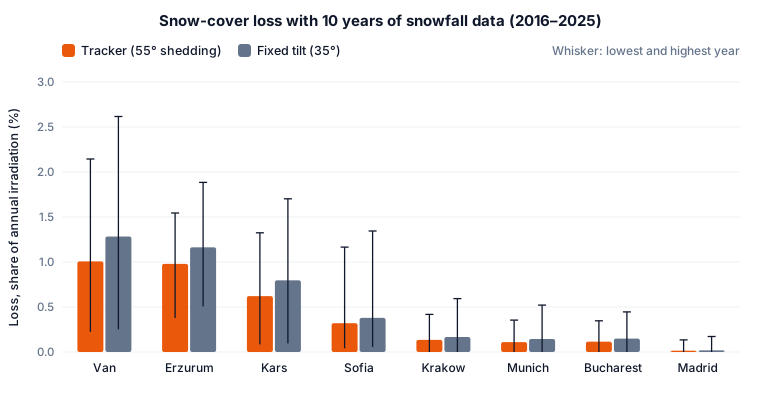
A single year is misleading, so do not read a one-year snow line in a yield report as a firm value. For cold sites, ask for a range built on multi-year snow data. See also our guide to P50 and P90.
What does a snow-shedding position gain?
A tracker can move to its maximum angle during snowfall, and snow slides faster off a steep surface. Keeping the same irradiance and snow series, we changed only the shedding angle:
| Site | 55° (shedding) | 30° | 15° |
|---|---|---|---|
| Erzurum | 0.98% | 1.40% | 2.17% |
| Van | 1.01% | 1.46% | 2.25% |
| Kars | 0.62% | 0.93% | 1.55% |
| Sofia | 0.32% | 0.45% | 0.69% |
| Munich | 0.11% | 0.17% | 0.28% |
The loss falls by more than half, but the absolute gain is in the tens of kWh/kWp at most. So the shedding position is valuable less for energy than for limiting snow build-up and load on the panels. Always ask the supplier whether it works during a power outage.
Why might the model understate the loss?
In the model, snow cover starts when hourly snowfall passes a threshold, 1.0 cm/h by default. ERA5 is a reanalysis at roughly 25 km resolution and spreads precipitation out: in Erzurum only 10 hours a year pass the threshold, out of an average 98 cm of snowfall. Light but long snowfalls may never enter the model. Lowering the threshold changes the picture:
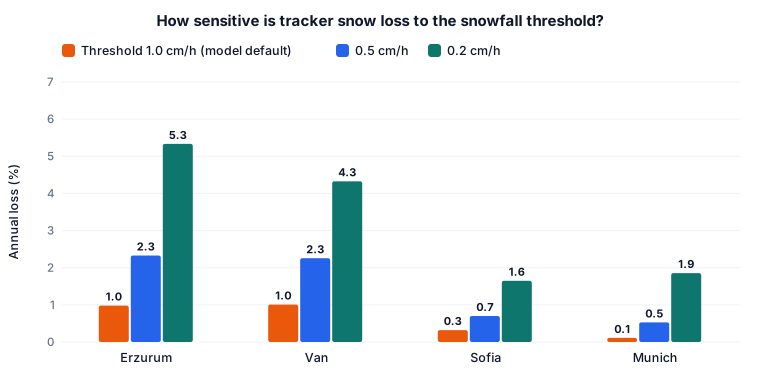
The model was also validated mainly on fixed-tilt systems (Marion et al., 2013), so tracker results are not confirmed by measurement. Before an investment decision at a snowy site, it is safer to treat the 1 cm/h result as the lower scenario and the 0.2 cm/h result as the upper one.
What if the snow has nowhere to slide?
This is the most overlooked point. Our model does not account for snow piling up on the ground. In the simulator's default geometry the axis height is 1.5 m and the panel length 2.38 m, so at 55° the lower edge sits about 0.52 m above ground. If ground snow reaches it, snow cannot slide, and snow touching the panel can hinder tracker movement.
By ERA5 snow depth, this level is passed on average 26 days a year in Erzurum and 12 in Van, and never in Munich or Sofia. In Erzurum those days carry 6.0% of annual irradiation on average and 26.5% in the worst year. That is not a loss estimate but a sign of the size of the risk. Coarse snow depth can misrepresent local conditions, so check the maximum snow depth at the nearest weather station and raise pile height if needed.
Does snow-covered ground increase output?
With bifacial panels, yes: snow reflects more light to the rear side. We repeated the simulation with this effect on and off (kWh/kWp·yr):
| Site | Snow-cover loss | Snow-ground albedo | Net | Tracker gain (no albedo effect) | Tracker gain (with albedo effect) |
|---|---|---|---|---|---|
| Erzurum | −19 | +51 | +32 | 17.5% | 18.6% |
| Van | −21 | +32 | +11 | 18.9% | 19.7% |
| Kars | −11 | +26 | +15 | 17.6% | 18.1% |
| Sofia | −6 | +19 | +13 | 15.2% | 15.7% |
| Munich | −2 | +4 | +3 | 12.4% | 12.5% |
At the default threshold, the albedo gain exceeds the cover loss. With a low threshold the balance reverses: at 0.2 cm/h, cover loss in Erzurum is about 102 kWh/kWp. Monofacial panels get no such benefit at all. In winter (December–March) the tracker's gain over fixed tilt is 9.0% in Erzurum and turns negative in Munich (2.2% below fixed tilt), because a 35° fixed panel already faces the low sun well. More in our bifacial and albedo article.
How does snow load affect tracker design?
Even if the energy loss is small, snow load is a structural limit. In EN 1991-1-3, roof snow load is s = μ · Ce · Ct · sk. For a pitched surface, the shape coefficient μ is 0.8 up to 30°, falls linearly between 30° and 60°, and reaches zero at 60°. At 55° that gives μ of about 0.13, or 6 times lower than below 30°.
Three important caveats:
- The standard is for roofs: for a tracker this coefficient is only indicative. The design value comes from the manufacturer's report and a qualified structural check.
- Blocked sliding removes the reduction: if snow rests on the ground pile, sliding is obstructed, and the standard requires 0.8 in that case.
- The tracker may not be at the right angle: an outage or fault can catch panels flat. Ask what load the structure carries in that position.
Ask your supplier for: the ground snow load allowed at each angle, how the snow position is triggered (sensor, weather data, manual), behaviour during outages, and pile height. String voltage is another cold-climate limit: 1500 V string sizing. For wind: wind stow strategy.
Method
Simulations used our pvlib-based tool: PVGIS typical meteorological year, 710 W bifacial panel, ±55° rotation with backtracking, 10 ha of land; fixed tilt at 35°. Snow cover: NREL/Marion model (pvlib.snow) with Open-Meteo ERA5 2016–2025 hourly snowfall; irradiance and temperature come from the typical year, so the true cloudiness of snow days is not reproduced exactly. Loss percentages are weighted by annual irradiation. Snow-ground albedo comes from the simulator's monthly snow climatology. Ground pile-up, contact with panels and wind drift were not modelled. The snow load section does not replace a project calculation.
Frequently asked questions
How much energy does snow cost a solar tracker plant?
In our simulation, on a 10-year average, about 1.0% in Erzurum and Van, 0.3% in Sofia and 0.1% in Munich. With a lower snowfall threshold, the upper scenario for Erzurum is 5.3%.
At what angle does a tracker shed snow?
Our simulation assumes the maximum angle of 55° during snowfall. The actual angle and trigger depend on the product, so ask the supplier in writing.
Is a tracker or fixed tilt better in snow?
In the model, snow-cover loss is slightly lower on the tracker: 1.0% against 1.2% in Erzurum. Where snow builds up on the ground, check the tracker's lower-edge clearance and mechanism separately.
Should piles be taller for snow?
It depends on the site. In the default geometry the lower edge is about 0.52 m above ground at 55°. If maximum snow depth at the nearest weather station approaches that, consider taller piles.
We deliver the whole project: feasibility, engineering, procurement, installation and grid connection, in Türkiye and abroad. Simulate your site for free first, then let our team prepare a tailored quote. Get a quote in 48 hours →
Start the Simulation and Get a Quote
The ratios on this page are typical industry ranges and are not binding; exact values are determined by a site-specific analysis.